Investment in Energy Science Opportunities
Structured pathways supporting energy research investment models.
Tax Equity Finance of Qualified Energy Research
Tax equity financing of qualified energy research is an investment structure designed to monetize certain federal income tax benefits associated with eligible research and experimental expenditures. Rather than seeking a conventional economic return based solely on future cash flows, a tax equity investor contributes capital to a research enterprise in exchange for an ownership interest that may provide access to valuable federal tax attributes generated through qualified research activities. The combination of current tax deductions, research tax credits, and potential long-term value from intellectual property may produce an after-tax economic return that exceeds the investor’s initial capital contribution, subject to applicable provisions of the Internal Revenue Code and Treasury Regulations.
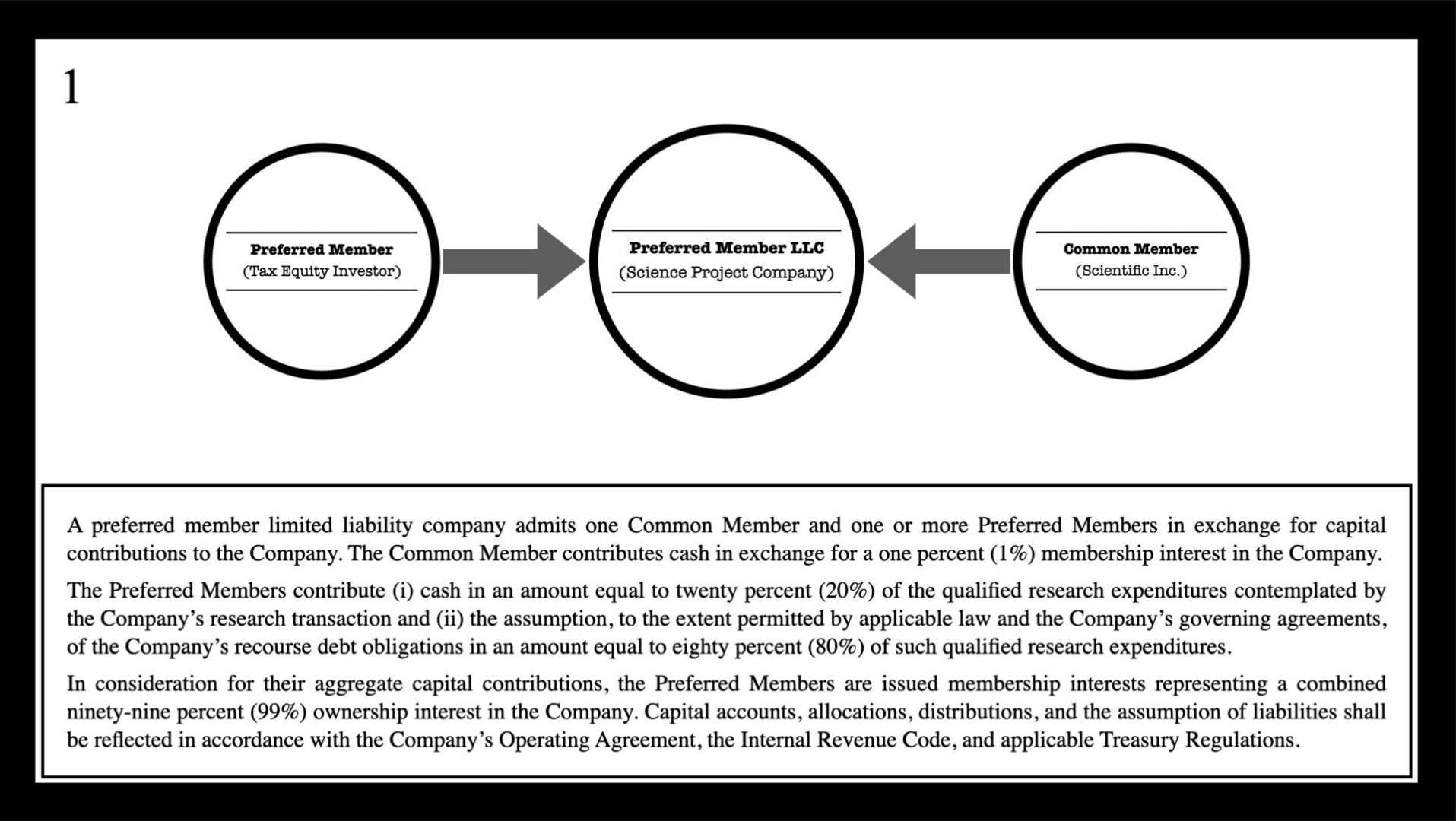
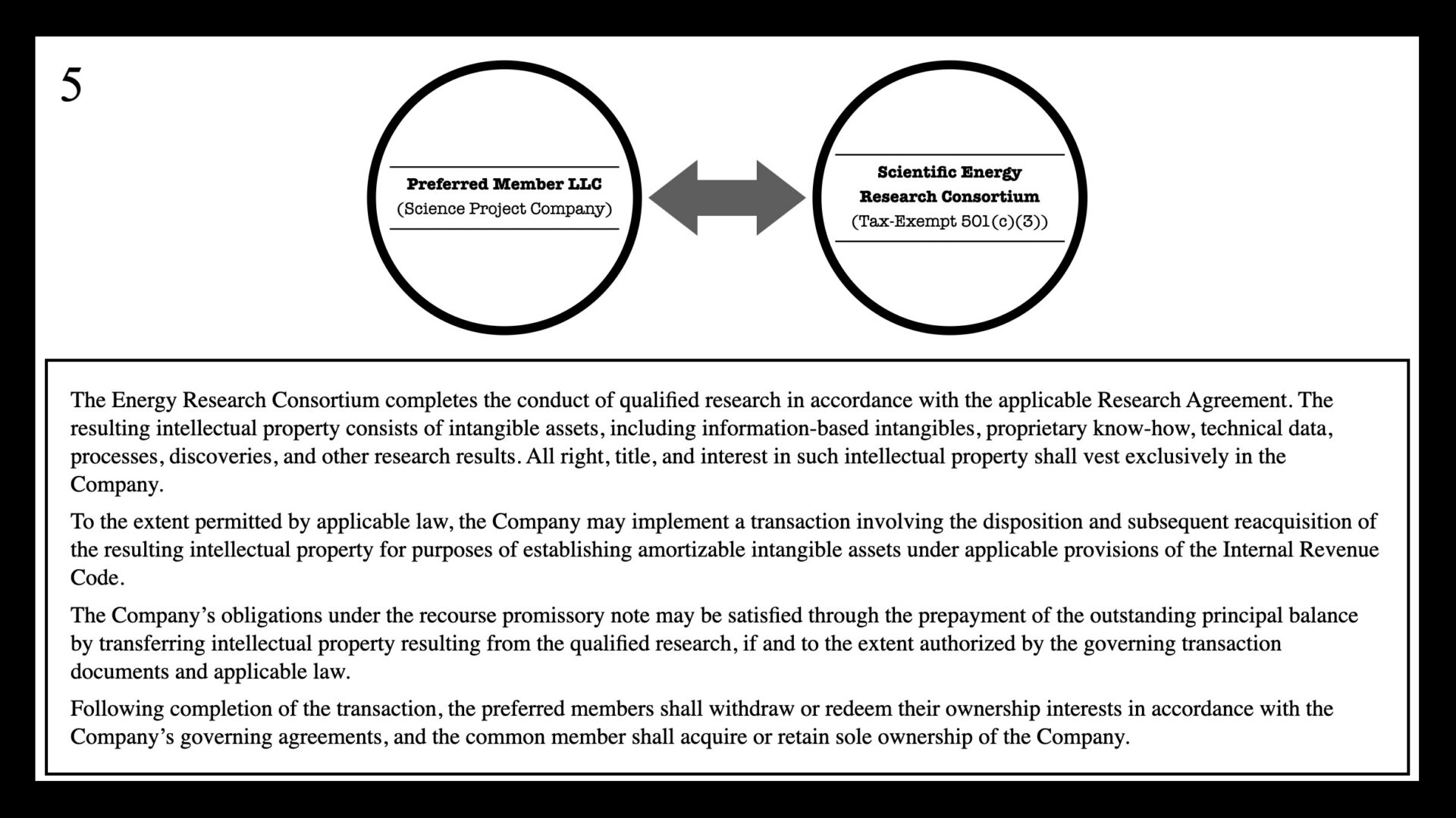
A typical transaction involves three principal parties: (1) an energy research consortium responsible for organizing and managing qualified research projects, (2) a preferred member limited liability company (“Preferred Member LLC”) that serves as the investment vehicle, and (3) one or more tax equity investors admitted as preferred members of the LLC. The common member generally manages the LLC and oversees administration of the research program, while the preferred members provide the capital necessary to finance qualified research.
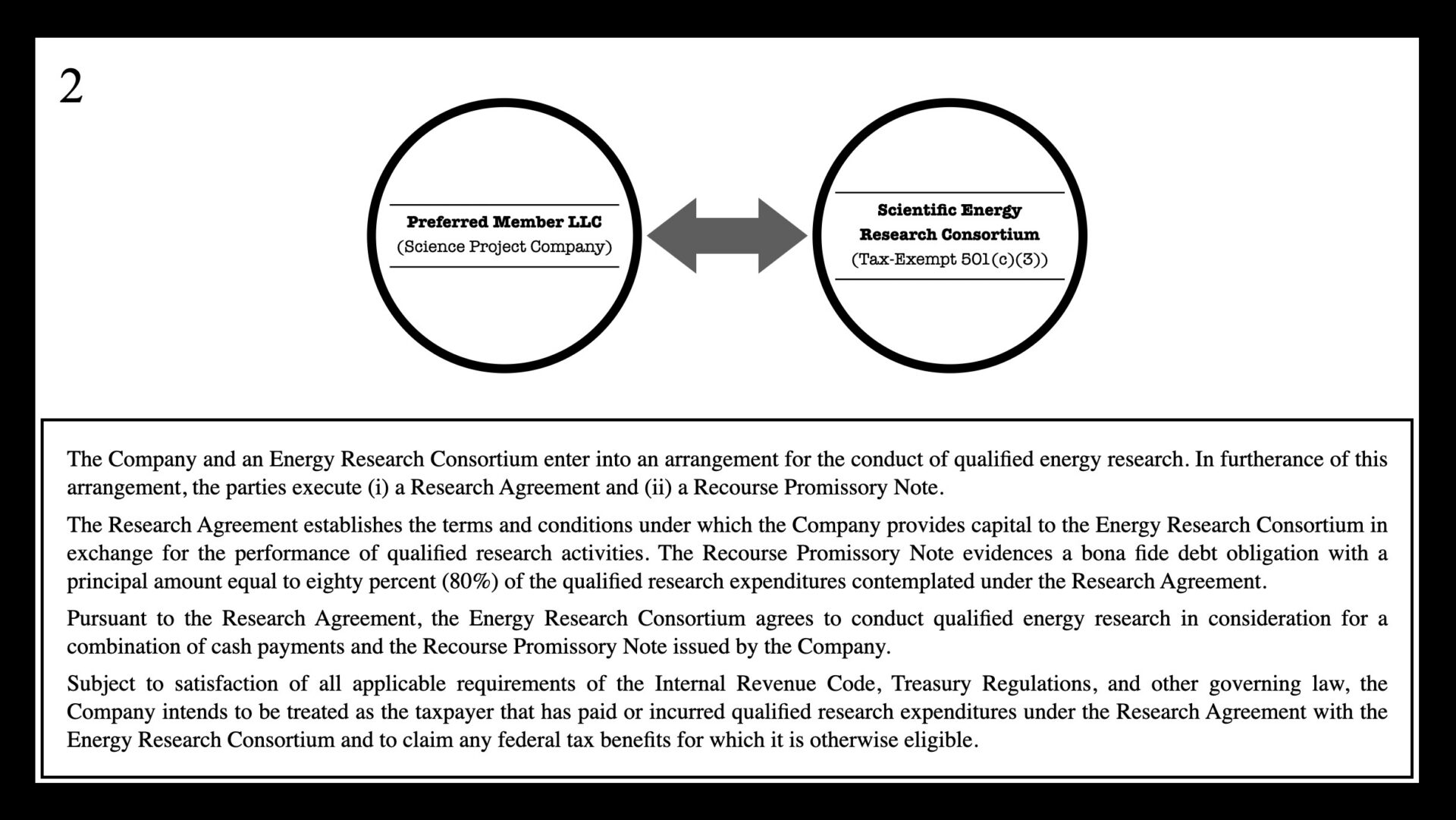
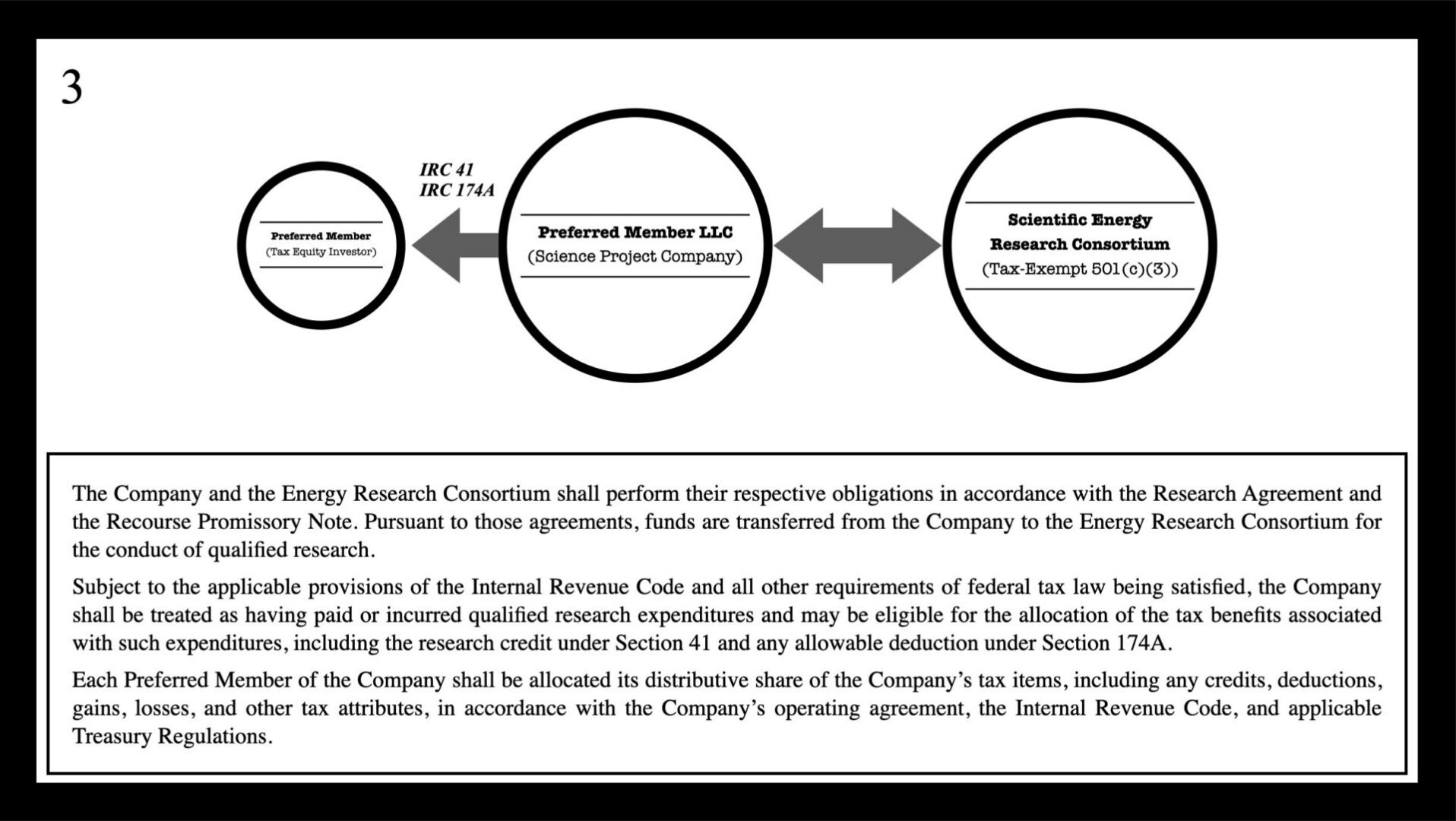
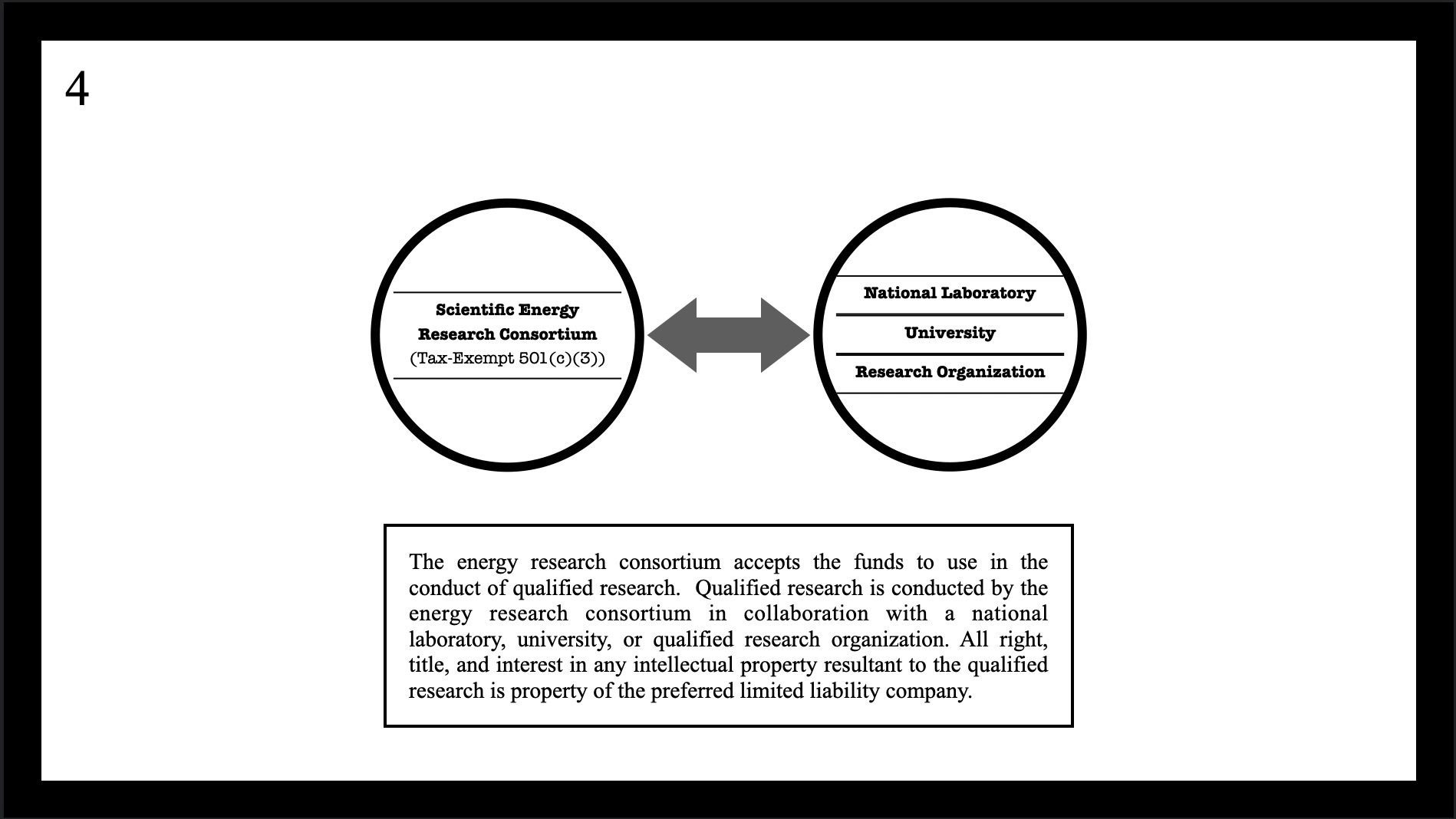
Under the proposed investment structure, a taxpayer-investor acquires a preferred membership interest in the LLC by making a capital contribution consisting of cash and, where appropriate and consistent with applicable tax and commercial law, the assumption or funding of certain research-related liabilities. The LLC subsequently contributes or pays these funds to Scientific, an energy research consortium, which coordinates qualified research through contracts with universities, national laboratories, engineering firms, scientific organizations, and other qualified research performers.
The consortium directs and supervises research intended to satisfy the statutory requirements for qualified research under the Internal Revenue Code. Activities generally include the development or improvement of products, processes, techniques, formulas, software, energy technologies, advanced materials, manufacturing methods, or other technological innovations through a process of experimentation intended to resolve technical uncertainty. Whether specific activities constitute qualified research depends upon the applicable statutory and regulatory requirements and must be evaluated on a project-by-project basis.
If the applicable statutory requirements are satisfied, the research expenditures may generate several categories of federal tax attributes. Qualified research expenditures may be eligible for the federal research credit under IRC §41, subject to the credit computation rules, substantiation requirements, and limitations contained in the Code and Treasury Regulations. In addition, research expenditures may be deductible, capitalized, or otherwise recoverable under the provisions governing research or experimental expenditures, depending upon the applicable version of the Internal Revenue Code, effective dates, and the taxpayer’s specific facts and circumstances. Since the enactment of the Tax Cuts and Jobs Act of 2017, many taxpayers are generally required to capitalize and amortize specified research or experimental expenditures under IRC §174, unless Congress provides otherwise through subsequent legislation.
Qualified research commonly produces valuable intellectual property and other intangible assets, including patents, patent applications, copyrights, software, trade secrets, proprietary processes, technical know-how, engineering data, research databases, designs, formulas, and other commercially exploitable technology. These intangible assets may possess significant economic value independent of the immediate tax benefits generated by the underlying research.
Depending upon the structure of subsequent transactions involving the resulting intellectual property, certain acquired intangible assets may qualify as amortizable IRC §197 intangibles. Whether an intangible qualifies for 15-year amortization under §197 depends upon the manner in which the intangible is acquired, whether it constitutes a §197 intangible as defined by the statute, and whether limitations such as the anti-churning rules contained in IRC §197(f)(9) or other statutory exceptions apply. A sale, transfer, contribution, reacquisition, or installment sale of intellectual property does not, by itself, ensure §197 treatment, and each transaction must be analyzed under the applicable provisions of the Internal Revenue Code, Treasury Regulations, and relevant judicial and administrative authorities.
Accordingly, a properly structured tax equity investment in qualified energy research may provide investors with a combination of federal research tax credits, recoverable research expenditures, ownership interests in valuable intellectual property, and other tax or economic benefits, while simultaneously supplying long-term financing for scientific innovation and technology development. The availability and amount of these benefits ultimately depend upon compliance with the Internal Revenue Code, Treasury Regulations, applicable accounting methods, partnership tax rules, and the specific facts of each transaction.
Investment Example
The following spreadsheet illustrates the use and application of the tax incentives provides by an investment into an Energy Research Consortium and its effect on the taxpayer’s taxable income and income tax. Investment results vary depending upon taxpayer income and taxpayer status.
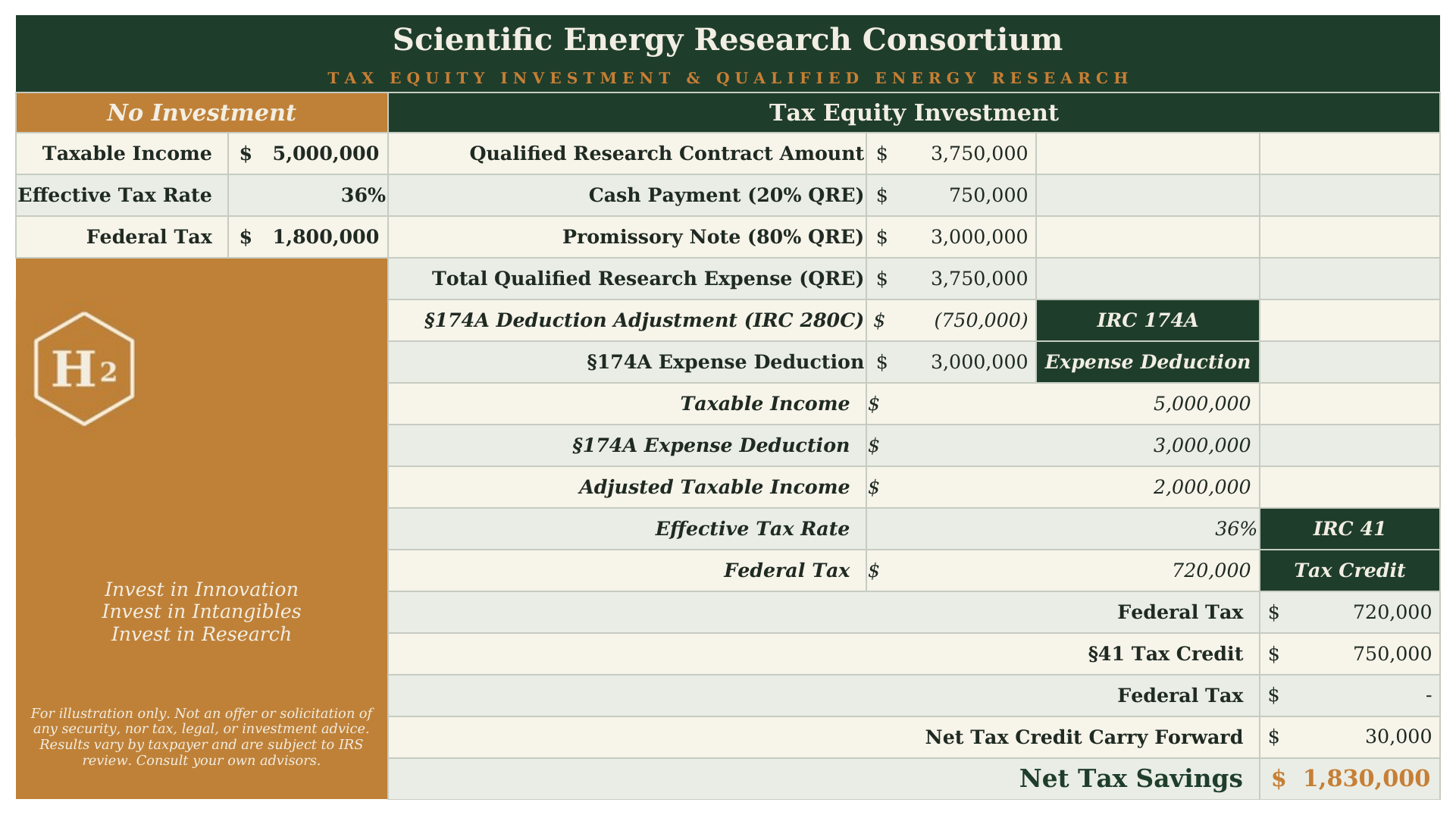
Assume a taxpayer-investor with a taxable income of $5,000,000 faces a federal tax bill of $1,800,000 at a 36% rate. The taxpayer-investor (as an LLC) enters into a research contract worth $3,750,000, paying $750,000 in cash and assuming $3,000,000 in debt. The total qualified research expense is $3,750,000. Under § 174A, the taxpayer-investor can deduct expenses equal to the qualified research expense minus the tax credit under § 41, which amounts to $3,000,000. This deduction lowers taxable income from $5,000,000 to $2,000,000, resulting in a reduced federal tax of $720,000 at a 36% rate. The taxpayer-investor also receives a tax credit under § 41 equal to 20% of the qualified research expense, or $750,000. This credit further reduces their federal tax from $720,000 to zero, allowing for a $30,000 net tax credit carryforward. In total, the net tax savings are roughly $1,830,000, while the total cost is approximately $750,000.
Tax benefits depend on your specific facts, applicable law, and IRS requirements. Consult your tax advisor before investing.